News Article
Showing Up Anyway
June 19, 2026
News Article
Chris Maxwell is a longtime EV driver and Plug-in NC ambassador.
When I signed up for Glizzies n’ Gainz at EB Athletics, I had a goal. Not to win. Not to set records. Just to finish in the top five of the Mild Division. For six months, I trained for it, and what began as a goofy-sounding fitness competition became something I genuinely looked forward to. My workouts revolved around rowing, deadlifts, bench press, overhead press, sled pulls, farmer’s carries, tire flips and whatever other creative suffering my coaches decided would be good for me. Considering that just a few years prior I had weighed 404 pounds and could barely imagine doing any of those things, preparing for Glizzies felt like proof that the work was paying off.
Then life happened. Long COVID has left me prone to inflammation. I got a cold. I got my COVID booster. I continued physical therapy, including dry needling in my Achilles. I increased my running volume to prepare for the event. My Achilles responded by partially tearing itself apart. That was back in February, and as I write this, stairs are still an unwelcome reminder that healing isn’t always on your timeline.
The original plan was gone. Which left me with a question: What does a gym rat do when he can’t compete?
He shows up anyway.
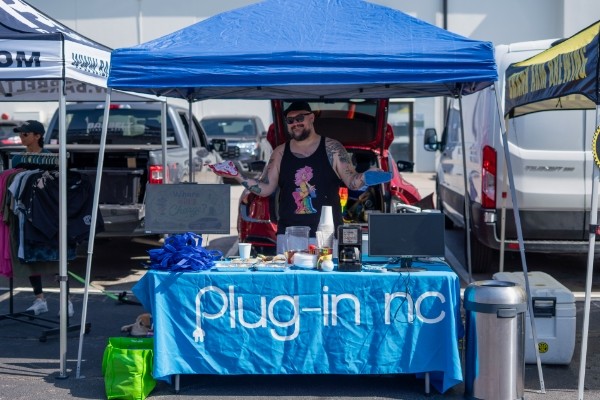
Instead of competing, I spent the day running the Plug-in NC booth and talking about my other passion: electric vehicles (EVs). The funny thing is that standing at that booth taught me the same lesson I’ve been learning in the gym for the last three years: Meaningful change happens a lot slower than most people want it to. When I crossed 400 pounds in 2023, I needed a dramatic transformation. What I got instead was a series of small decisions repeated over and over. Show up to the gym. Lift something heavy. Eat a little less, but better quality, food. Repeat tomorrow. There wasn’t a secret or a shortcut, only consistency, and today I’m down to 295 pounds.
EV adoption works exactly the same way. Nobody wakes up one morning and transforms transportation. It happens one conversation, one test drive, one charging station, one purchase at a time. The challenge is that progress often feels invisible while it’s happening.
Standing at the booth, I couldn’t help but think about where we are right now. I look back at my 3,744-mile electric motorcycle tour of 2021 and can’t believe how many more DC fast chargers exist on that route today. The world seems to be getting the message. Around the globe, EV sales continue to grow, new models are arriving at lower prices, consumers have more choices than ever, and countries are reducing oil dependence while building domestic energy resilience.
Meanwhile, here in the U.S., we’re still having many of the same arguments we were having 10 years ago. Sometimes it reminds me of talking to someone who desperately wants to lose weight but who always has a reason not to start. The gym is too expensive. The EV is too expensive. The weather isn’t right. The range isn’t enough. I’ll start next month. I’ll start when there are better incentives. We’ve all heard those excuses because most of us have made them ourselves.
Eventually, though, everyone reaches a breaking point. For me, it was crossing 400 pounds. For someone else, it might be a $4 gallon of gasoline. Perhaps it’s wanting cleaner air for your kids. Maybe it’s trying to stretch a paycheck further. Maybe it’s frustration with another overseas conflict affecting energy markets. The reason almost doesn’t matter.
What matters is deciding to do something, and there has never been a better time to switch to electric!
At our booth, we focused on something many people don’t immediately associate with EVs: They are a power bank. We weren’t talking about 0-to-60 times or tax credits. My Kia EV6 powered our booth, running two displays, a retro gaming station for kids, a toaster oven, a coffee maker, a tea maker and a fan. Throughout the day I cooked salmon bites, cheese-stuffed pepper poppers and muffins for anyone who wandered over. The point was simple: an EV isn’t just transportation; it’s a giant battery on wheels. For many owners, it’s the first step toward energy independence. It can power a campsite or elevate a tailgate. It can keep a CPAP machine running and medication refrigerated during an outage. It can provide comfort when the lights go out. Many people who stopped by seemed more interested in that than in the driving range, recharge time or battery warranty.
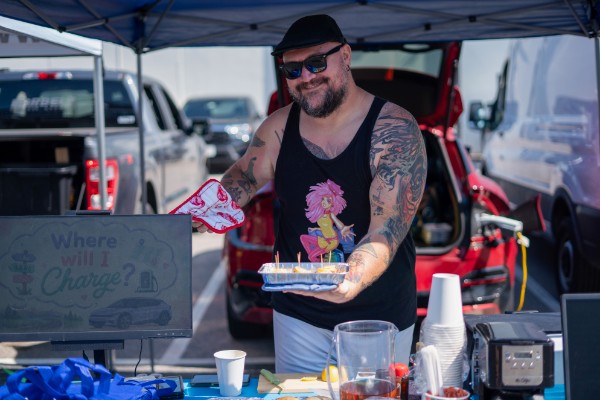
More than 20 people came by the booth throughout the day. Most didn’t ask technical questions; they wanted stories. What was my longest trip? Three thousand seven hundred forty-four miles across nine states on an electric motorcycle. How many electric miles have I driven? More than 365,000. People don’t connect with technology. They connect with experiences.
One conversation in particular stuck with me: A Ford F-150 Lightning owner who was running another booth talked about resistance to fleet electrification. During the discussion, he said that one manager stated that if they knew they only had 300 miles available in a day, they would structure their in-person meetings very differently. That comment hit harder than they probably intended, but we’ve become accustomed to the illusion of abundance. Unlimited gasoline. Unlimited time. Unlimited energy. Unlimited health. Reality eventually reminds us that none of those things are actually unlimited, and the people who succeed aren’t necessarily the people with the most resources. They’re the people who learn to use what they have more intentionally and effectively.
A few weeks after Glizzies n’ Gainz, The Purrfect Hearts Cat Rescue of Wilson, North Carolina, suffered a devastating fire. When I heard about it, I didn’t stop to calculate range, charging time, or whether it would be convenient. I loaded blankets, cat beds and cases of food into my Kia EV6 and drove them to a collection point in Wilson. I just showed up.
Lately it feels like everyone is carrying some degree of burnout. I know I am. But Glizzies reminded me that progress usually isn’t built through grand gestures. It’s built through a thousand small decisions that nobody notices at the time. Going to the gym when you’d rather stay home. Taking a test drive. Installing a charger. Answering one more question at an EV booth. Helping your neighbors when they need it.
Those actions don’t seem significant on their own. But stack enough of them together and they can change a life, a community or even how an entire country powers itself. That’s really what I took away from Glizzies n’ Gainz, not the competition itself, or the injury, or even the EV booth. It was the reminder that progress is rarely dramatic while it’s happening. Whether you’re trying to lose 100 pounds, recover from an injury, transition away from gasoline or help your community through a difficult moment, the formula is surprisingly similar: You don’t wait for perfect conditions, you don’t wait until you’re fully ready, and you don’t wait until someone else does it first.
You just show up.
And when the original plan falls apart, you pivot, and you show up anyway.