News Article
State of the State: North Carolina’s Fast Charging by the Numbers
February 12, 2025
News Article
We hear it all the time when talking to the public about electric vehicles (EVs): “I’ll get one when there’s more fast charging available.” But the truth is, even for drivers without access to Tesla Superchargers, the state has had adequate fast charging coverage for years. Now, that doesn’t mean there aren’t pain points, hard-to-reach places or areas where charger redundancy is desperately needed — especially for those who drive a Nissan Leaf with its CHAdeMO plug.
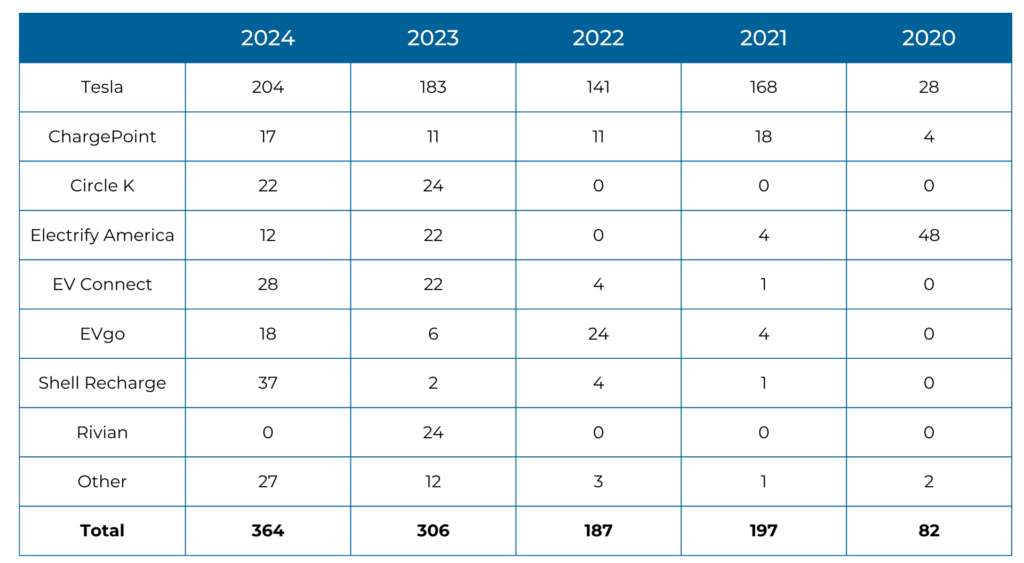
As we enter 2025, though, EV charging in North Carolina is more energized than ever, with 306 DC fast charging locations home to 1,385 total ports. It’s not perfect, and there’s still tons of work to do, but we took to the Alternative Fuels Data Center to pull some additional insights. Below, we show the approximate number of ports opened per charging network per year over the last five years.
Here are a few things that jump out to us:
The significant expansion of ports deployed by all network operators. The last two years have seen nearly double the number of deployments as the two years prior, which corresponds neatly with the EV registration growth observed during the same time frame in the state.
Tesla’s market share. Tesla’s counts are incredibly high and consistent over the last four years. What’s most notable, though, is that now almost all EV drivers have access to Tesla chargers, or will in the near future. This means that consumers who are interested in buying a non-Tesla EV but are worried about access to fast charging can use hundreds of more charging ports compared to even just a few months ago.
The scope of new deployments for Shell Recharge, EV Connect and Circle K over the last two years. Included in this count are the DC fast charge stations from Duke Energy’s Park & Plug program (which are mostly Shell Recharge, to our knowledge). Besides just being newer providers in this space (though see next point), what these network operators share is that they use various hardware types and work through site hosts. This means that more fueling centers (like Circle K) and grocery stores are taking matters into their own hands and installing DC fast charging because it’s good for business. Electrify America, Tesla and EVgo, in contrast, more typically own the equipment and just secure an agreement with a site host. To us, this suggests that 1) customers want to make their own decisions about their charging hardware; and 2) they see it as a market to participate in and not just one to pursue because Tesla or Electrify America comes and makes it easy.
With Shell Recharge going dark, site hosts and operators will need to figure out how (or if) they should transfer its assets to other networks. It’s not always easy, and it’s a frustrating reminder of market dynamics. But we expect that most, if not all, of the stations will be integrated into other networks.
We’ll end with additional thoughts that aren’t quite as clear from the table.
None of these charging stops are National Electric Vehicle Infrastructure (NEVI) sites, and very few (if any) were federally funded. Those stations have been planned for and have awards from the NC Department of Transportation, but they haven’t been installed/activated yet. The state is moving forward with nine NEVI-funded stations while the program is reevaluated.
There’s nothing about reliability. Network operators will ultimately succeed or fail based on how reliable their stations are. We’ve seen this over the last few years, with stations often down for long periods. As EV adoption grows and consumers have more charging options, it’s now in the best interest of station/network companies to ensure their equipment works. Otherwise, those kilowatt-hour sales are going to other chargers nearby.
Not all of the stations commissioned in 2024 are located in urban areas. For example, in Halifax, North Carolina, Tesla just added 48 new plugs to an existing site. It now has 60 stations, making it the largest DC fast charging location on the East Coast. This isn’t an area of high EV adoption but is one with high fast charging need: It’s along a major interstate and far enough away from large cities that the electrons are crucial for travelers on long drives.
Let’s remember that DC fast charge deployment isn’t the main focus for all the companies above. Many are prioritizing Level 2 charging options or private charging solutions for fleet providers. What we see isn’t the full story when it comes to what these charging providers are emphasizing.