News Article
Tools for Summer EV Road-Tripping
June 30, 2025
News Article
As summer travel heats up, it pays to know how to find reliable charging for your electric vehicle (EV) road trip.
PlugShare is a website and an app that provides charging station information (energy output, pricing, etc.) and locations (addresses). It’s key for mapping charging stops along your trip. I use it for “destination charging” so that I can see what charging is near my journey’s end — I like to know exactly where to go and what to expect when I get there.
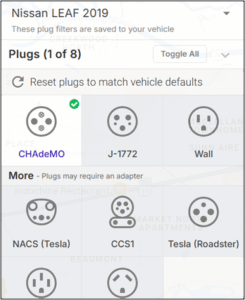
PlugShare lets you filter by plug type, so you can focus solely on charging you can actually use, including with any adapters you have. For example, my Nissan Leaf relies on CHAdeMO, meaning it’s important for me to identify the stations I know have this plug. Keep in mind that Tesla opened its Supercharger network to additional EVs, so you may have access to more charging options than you think.
You can also filter by PlugScore, which is a 0 to 10 rating (10 being the best) based on people’s broad success charging at a particular location.
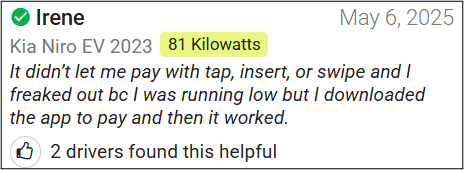
More beneficial, in my opinion, is the ability to view others’ prior check-ins. This feature gives insight into which EV models have effectively charged at a location and may include written details about users’ experiences. The most recent comments are your friend, providing the best sense of the state of that charging site before you arrive. These check-ins were invaluable on my last road trip — I learned that a station on my route had a broken credit card reader and therefore required an app for payment. This knowledge helped me plan ahead and initiate charging with ease. Thanks, Irene!
A Better Routeplanner is another tool that allows you to coordinate your charging along a road trip. I typically use it for “en route charging” so that I can see what charging is on the way to my destination. However, this resource may be less attractive for those with built-in charging route optimization in their EV navigation system.
A Better Routeplanner lets you input information like your vehicle model, charging adapters, state of charge (SOC) upon departure/desired SOC upon arrival, and preference for fewer longer stops vs. more frequent quick stops vs. quickest arrival. Below is an example for a trip I took from Durham to Wilmington. While this trip was relatively straightforward, a longer one would follow the same basic process. I made the following selections:
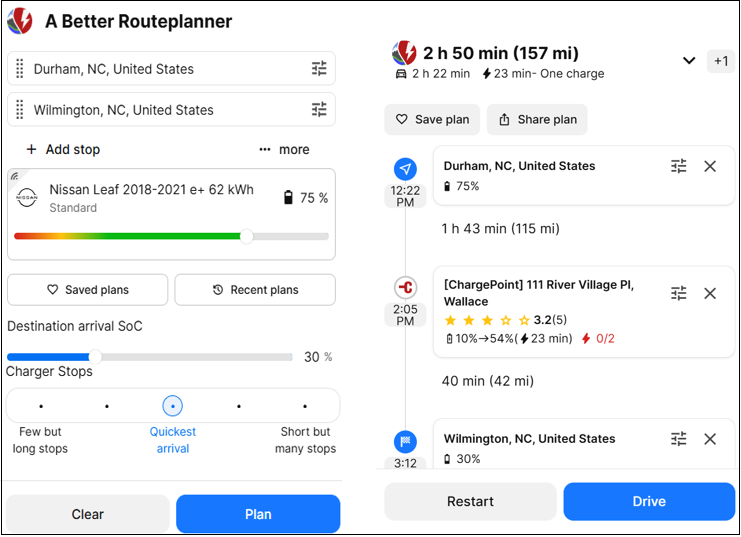
You can really get into the weeds with A Better Routeplanner and explore any number of settings, including:
And while on your trip, consider charging etiquette and how to be a good steward of charging stations. Below are best practices that we elaborate on here.
Happy traveling!